|
Mosca, Colorado USA
Cultural History
 The
Human Connection The
Human Connection
No man is an island entire of itself; every man is a piece
of the continent, a part of the main....Any man's death diminishes
me because I am involved in Mankind; and therefore never send
to know for whom the bell tools; it tolls for thee.
John Donn
People and the Dunes:
an Enduring Connection
Human Beings have known about,
visited, or lived near the Great Sand Dunes for a long, long
time. The oldest evidence of humans in the area dates back
about 11,000 years.
Making a Living: Early People
of 11,000 years ago
Some of the first people to
enter the San Luis Valley and the Great Sand Dunes were nomadic
hunters and gatherers whose connection to the area centered
around the herds of mammoths and prehistoric bison that grazed
nearby. They were Stone Age people who hunted with large stone
spear or dart points now identified as Clovis and Folsom points.
Like nearly everyone else until about 400 years ago, they
walked into the San Luis Valley, apparently spending time
here when hunting and plant gathering was good, and avoiding
the region during times of drought and scarcity.
A Living Connection: Modern American Indians
Although we don't know the
names or the languages of those earliest people, modern American
Indian tribes were familiar with the area when Spaniards first
arrived about 400 years ago. The traditional Ute word for
the Great Sand Dunes is sowapophe-uvehe, "The land that
moves back and forth." Jicarilla Apaches settled in northern
New Mexico and called the Dunes ei-anyedi, "it goes up
and down," Blanca Peak, just southeast of the Dunes,
is one of the four sacred mountains of the Navajo. What was-and
is-the connection for these people?
For the Jicarilla Apache and
southern Ute tribes, it is a practical matter: they camped
and hunted in the San Luis Valley. While they were here at
the Dunes, they collected the inner layers of bark from ponderosa
pine trees, useful to them as food and medicine. For the people
from Tewa/Tiwa-speaking pueblos along the Rio Grande, it is
a spiritual link. They remember a traditional site of great
importance located in the San Luis Valley near the Dunes:
the lake through which their people emerged into the present
world.
"This was one of the
places that the Utes used to gather…the Capulta band were
the ones that used to camp in this area. Neighboring families
would come here and camp with them?this was maybe early in
the spring or late in the fall. The Utes used to use the bark
from the ponderosa pine for medicinal purposes, and also for
food sources…they would cut the bottom, pulling it apart.
That's the way they harvested. The younger kids would help,
to a certain age, but basically it was all the women that
did the harvesting of the trees, and they're the ones that
picked the trees out…"
Alden Narango, Southern Ute
tribal historian
Spanish Explorations:
Don Diego de Vargas, 1694
Juan Bautista de Anza, 1776
In 1694, Don Diego de Vargas
became the first European known to have entered the San Luis
Valley, although herders and hunters from the Spanish colonies
in present-day northern New Mexico probably entered the Valley
as early as 1598. De Bargas and his men saw and hunted a herd
of 500 bison, apparently in the southern part of the Valley,
before returning to Santa Fe.
In 1776, Juan Bautista de
Anza and a huge entourage of men and livestock probably passed
near the Dunes as they returned from a punitive raid against
a group of Comanches. At this time, the San Luis Valley was
a travel route between the High Plains and Santa Fe for Comanches,
Utes, and Spanish soldiers. For some of them, the Dunes were
likely a visible landmark along the trail.
Westward Expansion:
Zebulon Pike, 1807
 The first known writings about
the Dunes appear in Zebulon Pike's journals of 1807. As Lewis
and Clark's expedition was returning east, U.S. Army Lt. Pike
was commissioned to explore as far west as the Arkansas and
Red Rivers. By the end of November 1806, Pike and his men
had reached the site of today's Pueblo, Colorado. Still pushing
southwest, and confused about the location of the Arkansas
River, Pike crossed the Sangre de Cristo Mountains just above
the Great Sand Dunes. His journal from January 28th, 1807,
reads: The first known writings about
the Dunes appear in Zebulon Pike's journals of 1807. As Lewis
and Clark's expedition was returning east, U.S. Army Lt. Pike
was commissioned to explore as far west as the Arkansas and
Red Rivers. By the end of November 1806, Pike and his men
had reached the site of today's Pueblo, Colorado. Still pushing
southwest, and confused about the location of the Arkansas
River, Pike crossed the Sangre de Cristo Mountains just above
the Great Sand Dunes. His journal from January 28th, 1807,
reads:
"After marching some
miles, we discovered…at the foot of the White Mountains [today's
Sangre de Cristos] which we were then descending, sandy hills…When
we encamped, I ascended one of the largest hills of sand,
and with my glass could discover a large river [the Rio Grande]…The
Sand-hills extended up and down the foot of the White Mountains
about 15 miles, and appeared to be about 5 miles in width.
Their appearance was exactly that of a sea in storm, except
as to color, not the least sign of vegetation existing thereon."
John C. Fremont, 1848
John Gunnison, 1853
1n 1848, John C. Freemont
was hired to find a railroad route from St. Louis to California.
He crossed the Sangre de Cristos in the San Luis Valley in
winter, courting disaster but proving that a winter crossing
of this range was possible. He was followed in 1853 by Captain
John Gunnison of the U.S. Topographical Survey. Gunnison's
party crossed the dunefield on horseback: "Touring the
southern base of the sand-hills, over the lowest of which
we rode for a short distance, our horses half burying their
hoofs only on the windward slopes, but sinking to their knees
on the opposite, we for some distance followed the bed of
the stream from the pass, now sunk in the sand, and then struck
off across the sandy plain…The sand was so heavy that we were
six hours and a half making ten miles…"
Routes into the Valley
In the years that followed,
the Rockies were gradually explored, treaties were signed
and broken with resident tribes, and people with widely differing
goals flooded into Colorado from the United States and Mexico.
In 1852, Fort Massachusetts was built and then relocated to
Fort Garland, about 20 miles southeast of the Great Sand Dunes,
to safeguard travel or settlers following the explorers into
the San Luis Valley.
Although many settlers arrived
in the San Luis Valley via the trails from Santa Fe or La
Veta Pass, several routes over the Sangre de Cristo Mountains
into the San Luis Valley were well-known to American Indians
and increasingly used by settlers in the 1800s. Medano Pass,
also known as Sand Hill pass, and Mosca Pass, also called
Robidoux's Pass, offered more direct routes form the growing
front-range cities and dropped into the San Luis Valley just
east of the Great Sand Dunes. Trails were improved into wagon
routes and eventually into rough roads. The Mosca Pass Toll
Road was developed in the 1870s, and stages and the mail route
used it regularly through about 1911. That year, the western
portion was badly damaged in a flash flood. Partially rebuilt
at times in the 1930s through the 1950s, it has been repeatedly
closed by flooding and is now a trail for hikers.
Making a Home: Homesteaders
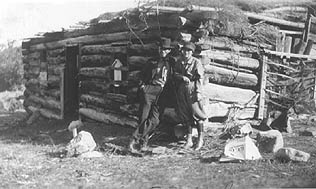
Homesteader Ulysses Herard,
who with his family established a ranch and homestead along
Medano Creek in 1875, would have used the old Medano Pass
Road to travel to and from his home. The modern road, open
only to 4WD, high clearance vehicles, follows the old route,
skirting the dunefield before rising to Medano Pass and continuing
east into the Wet Mountain Valley. The Herards grazed and
bred livestock in the mountain meadows, built a home, raised
horses, cattle, and chickens, and established a trout hatchery
in the stream.
Other families homesteaded
near the Dunes as well, including the Teofilo Trujillo family,
who raised sheep west of the Dunes. And Frank and Virginia
Wellington, who built the cabin and hand-dug the irrigation
ditch that parallels Wellington Ditch Trail, just south of
today's campground. Their son, Charles, ran a sawmill on Sawmill
Creek, just north of the campground.
As people established homes,
they often petitioned the U.S. Postal Department for post
offices to serve their tiny villages. Zapata (1879); Blanca
or North Arrastre; Orean (1881); Mosco (1880); later called
Montville (1887-1900); Herard (1905); Liberty (1900); Duncan
(1892) and others helped connect isolated homesteaders with
the larger world.
Seeking Wealth: The Gold Rush, 1853 and later
Gold and silver rushes occurred
around the Rockies after 1853, bringing miners by the thousands
into the state and stimulating mining businesses that operate
to this day. Numerous small strikes occurred in the mountains
around the San Luis Valley. People had frequently speculated
that gold might be present in the Great Sand Dunes, and in
the 1920s, local newspapers ran articles estimating its worth
at anywhere from 17 cents/ton to $3/ton. Active placer mining
operations sprang up along Medano Creek, and in 1932 the Volcanic
Mining Company established a gold mill designed to recover
gold from the sand. Although minute quantities of gold were
recovered, the technique was too labor-intensive, the stream
was too seasonal, and the payout was too small to support
any business for long.
Preserving the Beauty: Establishing a National Park Service
Site
The idea that the Dunes could
be destroyed by gold mining or concrete-making alarmed residents
of Alamosa and Monte Vista. By the 1920s, the Dunes had become
a source of pride for local people and a potential source
of tourist dollars for local businesses.
Members of the Ladies PEO
sponsored a bill to Congress asking for national monument
status for the Great Sand Dunes. Widely supported by local
businesses and Chanbers of Commerce, the bill was signed into
law in 1932 by President Herbert Hoover.
Living at the Dunes
Imagine: you are standing on the edge of a shallow lake, surrounded
by cattails and birdsong. The dunes hover on the horizon to
the north. You're carrying a small fiber pouch filled with
sharp flakes of stone, and you're wearing very little-to what
time do you belong? Or again, it's a summer day and you're
bridling your horse at Montville, Colorado and listening to
the flies buzz. You wear the blue and gold of a cavalryman.
When and where are you? And once again: you're digging a shallow
pit in the side of an old grass-covered dune. Carefully you
photograph the layers of different colored sandy soils you
observe before digging deeper. What are you doing-and why?
Students in the future may
be able to identify all three of the characters sketched above
as people who lived part of their lives at the Great Sand
Dunes, thanks to a four-year research project that began summer
2000. "This is a pretty neat project," states Resource
Specialist Fred Bunch. "It's really a chance to look
at all kinds of different reasons that all kinds of different
people visited the dunes over a long, long time." Bunch
is coordinating this project, but it's an interdisciplinary
group of researchers and volunteers who are making it happen,
including scientists who specialize in archeology, anthropology,
geology, ethnography, and the Great Sand Dunes staff.
Traditionally, Great Sand
Dunes National Park has been known as a 'geology' park - one
where the most obvious stories revolve around the landscape
and its formation. Questions about the dunes and how they
formed continue to be some of the most commonly asked. However,
local history tells the human side of the story as well; there
is plenty of oral and written evidence of people visiting,
passing by, or living for a time near the dunes. The Great
Sand Dunes Eolian System Archaeological and Ethnographic Project
is an attempt to better understand how people have interacted
with the land around the dunes over time.
Some of the basic questions
this project addresses and the researchers involved include:
How have people through time
used what appears, at first glance, to be a constantly changing
landscape? Dr. Richard Madole is a geomorphologist, one who
studies the formation and evolution of landforms. He is concentrating
on the 'eolian system'-that is, the wind influenced sand deposits-with
a focus on understanding how the dunes, sand sheet, and sabkha
have changed over time, and when those changes occurred. With
that data, he and his colleagues can then consider how those
changes could have affected people in the area.
How has climate change affected how people lived near the
dunes over the past 13,000 years? Drs. Pegi Jodry and Dennis
Stanford, a wife and husband team of archaeologists from the
Smithsonian Institution, have been working in the San Luis
Valley for years. In summer 2000 and 2001, they surveyed or
excavated several sites near springs on the Medano Ranch,
just west of the main dunefield. "The Medano Ranch is
really a wonderful opportunity," says Dr. Jodry. "We
can gather data about human use there from Clovis times [about
12,000 years ago] to the present. It's amazing to think about,
but the larger story of ancient humans in the San Luis Valley
is really about how they adapted to the changing availability
of water. As wetlands expanded or contracted over time, people
used different options for making a living." For more
on Pegi's and Dennis' work in the San Luis Valley and beyond,
see the December 2000 issue of the National Geographic Magazine
and Volume 2 (1) of American Archaeology Magazine.
How were pin-juniper forests of foothills used through time?
Pin-juniper forests offer plentiful resources to hunters
and gatherers-pin nuts, fuel, habitat for game animals-and
so can give glimpses of how people in the past made their
living near the dunes. Archaeologists Ted Hoefer and Marilyn
Martorano and their teams began surveying known sites in the
pin-juniper forest of the foothills east of the dunefield
in summer 2000, after a wildfire had burned over many of the
sites. In summer 2001, they continued their work and included
Denton Springs and Montville, both sites that were occupied
or used by ancient people as well as more modern ranchers,
settlers, park visitors, and park staff.
What do American Indians living today have to say about the
dunes and the San Luis Valley? Ethnographer David White began
contacting tribes with ties to the San Luis Valley in 2000,
initially focusing on the Jicarilla Apache, the Tewa Pueblo,
and the Ute as groups known to have traditionally used or
visited the area. In the next phase of his research, he hopes
to contact the Tiwa and Towa Pueblos, the Navajo, the Comanche,
Cheyenne, and Arapaho. For some of the people, the connection
is not so much one of subsistence as spirituality-the Jicarilla
Apache still collect sand from the dunes to create sand paintings
used in healing ceremonies, and the Tewa regard the San Luis
Lakes, just south of the dunes, as an important part of their
creation story. Dr. White is quick to point out that the ethnographic
story of the area is much larger than the current project,
and could easily include the descendants of other tribes as
well as of the European, Hispanic, and Asian people who settled
in the San Luis Valley in the last few centuries.
Want to learn more about who was here, when, and why?
Pick up a copy of "The
Hourglass" at the Visitor Center, for a summary of some
of the findings from the archeology project described above.
Ask at the Visitor Center to see the video "Sacred Trees"
which features members of the Ute tribe describing how ponderosa
pine trees in the monument were used by their ancestors.
Consider purchasing "A Colorado Pre-History: A Cultural
Context for the Rio Grande Basin", authored by several
of the researchers mentioned here. Available at the Visitor
Center bookstore, and may be found in your local library.
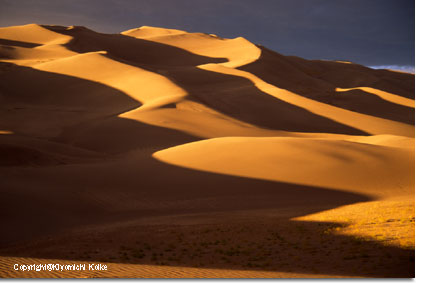
[This website is created to show the beauty
and wonder of a great american natural treasure. The contents
are courtesy of the National Park Service. It is created in
English and in Japanese. All the photo images shown here,
except the black & white photo onthe top which is a courtesy
of the Great Sand Dunes National Park and Preserve, are taken
by Kiyomichi Koike. The copy rights are reserved.]
|